



What is the difference between saturated polyester resin and unsaturated polyester resin
 Oct 20, 2026|
 View:49
Saturated polyester resins are thermoplastic and carry no reactive double bonds, while unsaturated polyester resin is thermoset and contains double bonds that crosslink during curing. This distinction matters to engineers and specifiers. It governs the curing method, the mechanical and thermal properties, the processing equipment, and the final cost. A specifier who ignores the difference risks choosing a resin that cannot survive the intended process or service environment. The comparison below examines chemical structure, curing behavior, key properties, processing routes, and typical applications. Each factor offers practical guidance for matching the right resin type to a specific end use.
Key Takeaways
Saturated polyester resins are thermoplastic and have no reactive double bonds, so they can be melted and reshaped.
Unsaturated polyester resins are thermoset and contain double bonds that crosslink during curing, making them permanently rigid.
Choose saturated resins for coatings, films, and adhesives that need flexibility and outdoor durability.
Choose unsaturated resins for structural composites that require rigidity, heat resistance, and chemical resistance.
Always match the resin type to the end use, processing method, and budget for the best result.
Chemical Structure Compared
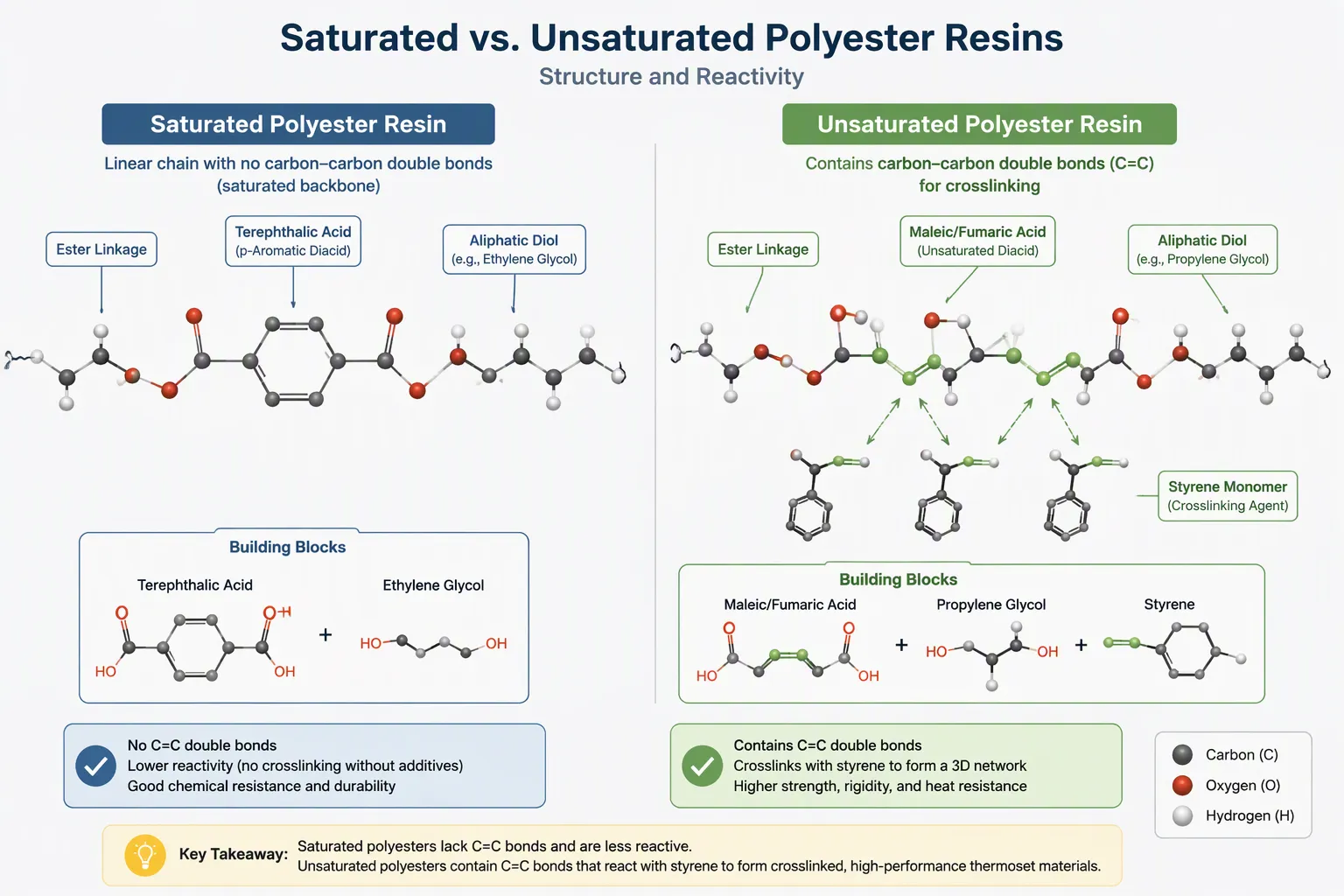
The two resin families share a polyester backbone, yet their building blocks set them on different paths. One stays thermoplastic, and the other becomes thermoset. The table below summarizes the structural contrast.
Resin Type | Diacid Building Blocks | Polymer Backbone Structure | Presence of C=C Double Bonds |
|---|---|---|---|
Saturated polyester resin | Saturated diacids (e.g., terephthalic, isophthalic, adipic acid) | Linear or lightly branched polymer | Absent — no reactive double bonds in the backbone |
--- | --- | --- | --- |
Unsaturated polyester resin | Unsaturated diacids (e.g., maleic, fumaric acid) | Backbone containing carbon–carbon double bonds | Present — enables crosslinking with vinyl monomers (e.g., styrene) during curing |
Saturated Polyester Structure
Saturated polyesters are linear polymers. Saturated diacids such as terephthalic, isophthalic, or adipic acid react with diols to build the chain. The backbone carries no carbon-carbon double bonds. This absence defines the material. Nothing along the chain can react with a crosslinking monomer, so the polymer stays thermoplastic. It softens on heating and hardens on cooling, and it can repeat this cycle. A lightly branched variant exists, but the chemistry remains non-reactive. The structure serves coating, film, and adhesive duties well, where flexibility and outdoor durability matter more than rigidity.
Unsaturated Polyester Structure
An unsaturated polyester resin starts from unsaturated diacids such as maleic or fumaric acid. Ring-opening of maleic anhydride installs a cis-butenedioate (maleate) unit into the backbone. At synthesis temperatures above 180°C, part of this unit isomerizes to the trans-fumarate form. The trans geometry aligns the double bond better for copolymerization, so fumarate units react roughly 3–5 times faster toward styrene than maleate units. A typical synthesis at 200–220°C yields a fumarate-to-maleate ratio of about 60:40. These backbone double bonds act as crosslinking sites. During curing, an initiator such as MEKP peroxide with a cobalt accelerator triggers the reaction with styrene monomer. Each styrene molecule bridges two backbone double bonds, one in each chain, and builds a three-dimensional network. A styrene-to-polyester ratio of about 1:2 by weight gives roughly one crosslink per 2–3 maleic anhydride units. The result is a rigid thermoset with no melting point.
Both architectures serve valid purposes. The saturated chain offers melt-processability and outdoor stability. The unsaturated chain offers a reactive backbone that locks into a network. Neither structure is superior in itself. The end use decides which chemistry fits.
Unsaturated Polyester Resin Curing and Processing
Thermoplastic Processing of Saturated Resins
Saturated polyesters behave as thermoplastics. Heat softens the polymer, and cooling hardens it again. Processors exploit this cycle through melting, extrusion, or powder coating. A powder coating line melts the resin onto a substrate and fuses it into a continuous film. An extrusion line shapes the melt into film or profile. No chemical reaction locks the chain in place, so the material can be reprocessed. This melt-based route suits coating, film, and adhesive production, where flexibility and outdoor durability drive the specification.
Crosslinking of Unsaturated Resins
An unsaturated polyester resin is a two-component thermoset system. The resin side holds the polyester and styrene, stabilized by inhibitors that prevent premature polymerization. The second component is the initiator, typically methyl ethyl ketone peroxide (MEKP). Cobalt salts such as cobalt octoate or naphthenate act as redox promoters. They catalyze MEKP decomposition at ambient temperature, so the system cures at room temperature or with mild heating. Once crosslinked, the part cannot be remelted.
The cure follows a free-radical route. MEKP decomposes into free radicals. Styrene monomer then copolymerizes with the reactive double bonds along the polyester backbone, bridging chains into a rigid three-dimensional network. The reaction is exothermic. Peak exotherm temperatures typically reach 120–180°C depending on formulation and catalyst concentration, and gel times range from 5 to 30 minutes under ambient conditions. That internal heat sustains crosslinking through the laminate thickness.
Curing parameters are tunable. Formulators adjust gel time, reactivity, and viscosity to match a specific process and local climate. A fabricator in a hot climate needs a slower gel time than one in a cold shop. Rixin tailors these parameters through custom formulation, so each unsaturated polyester resin grade fits its intended method.
Key Property Differences
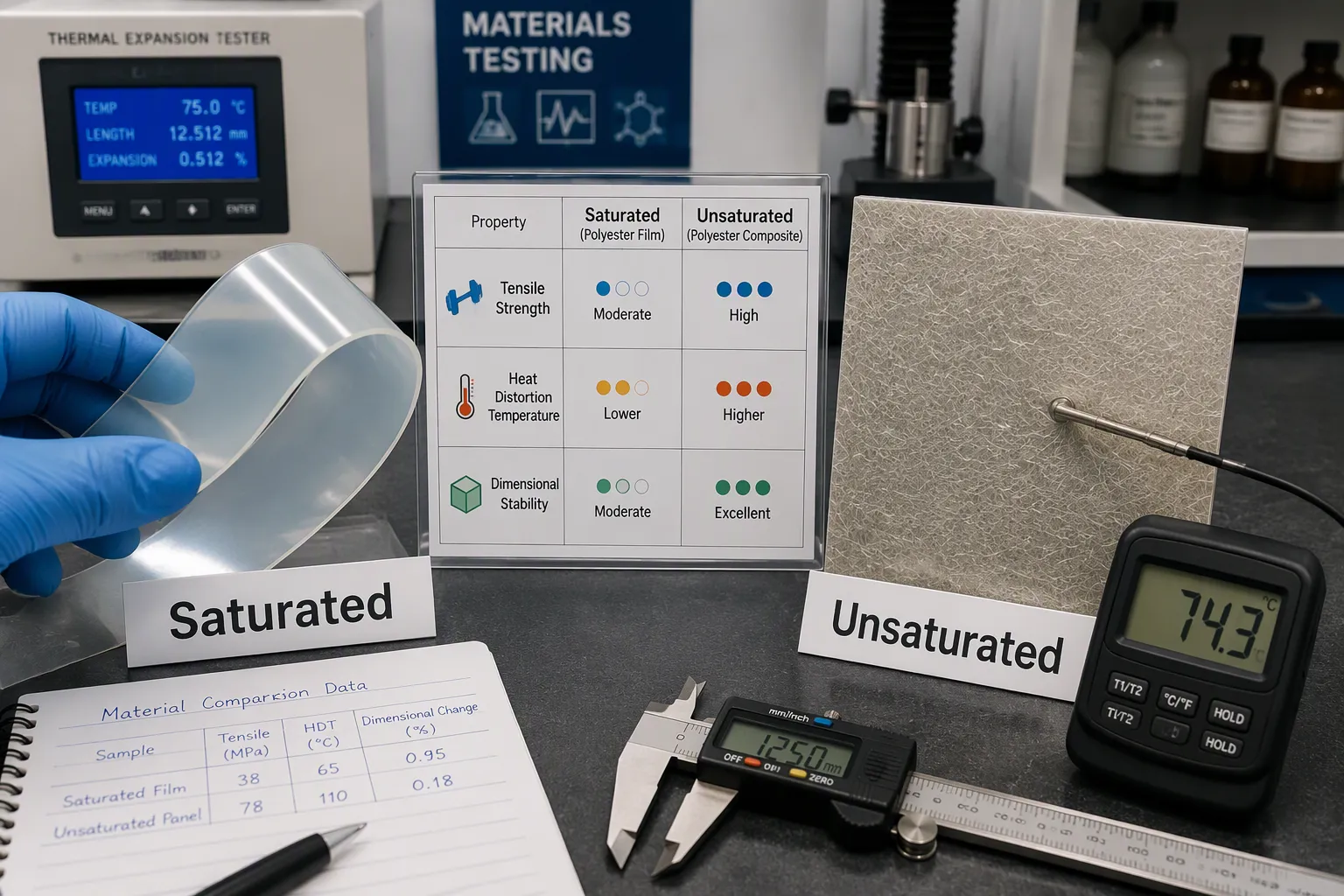
The two resin families diverge sharply once cured or cooled. The table below summarizes the main contrasts. Values marked as qualitative reflect formulation-dependent behavior rather than a single fixed figure.
Property | Saturated Polyester Resin | Unsaturated Polyester Resin |
|---|---|---|
Tensile strength | Moderate; formulation dependent | High in reinforced composites; formulation dependent |
Heat distortion temperature | Lower; softens on heating | Higher; glass transition temperature up to 141 °C in cured systems |
Dimensional stability | Good in film and coating form | Excellent; linear thermal expansion as low as 77 ppm/°C |
Chemical resistance | Moderate; suited to mild service environments | Broad range across pH 1–14 with appropriate grade selection |
Weatherability | Excellent outdoor durability | Good to excellent; grade dependent |
Mechanical and Thermal Properties
Flexibility separates the two materials clearly. Saturated polyester resin stays thermoplastic and delivers high flexibility. Unsaturated polyester resin offers moderate to high flexibility that depends on formulation. Impact behavior follows the same pattern. Cured unsaturated systems show excellent dimensional stability and impact resistance under long-term mechanical load, and automotive parts built from them demonstrate good impact resistance and durability.
Thermal performance favors the thermoset. A primary study on a cured unsaturated polyester resin reports a glass transition temperature of up to 141 °C and a decomposition onset near 250 °C. The same study measured a linear thermal expansion coefficient as low as 77 ppm/°C. That low expansion supports superior dimensional stability, which matters in fiberglass-reinforced composites where resin and reinforcement must move together under heat. Thermal expansion mismatch drives stress at interfaces, so a low coefficient protects bond integrity. Saturated polyesters soften on heating by nature, which limits their use in load-bearing hot service.
Chemical and Weather Resistance
Chemical resistance depends heavily on grade selection. Orthophthalic grades handle mild chemicals only and suit less demanding jobs such as covers or trays. Isophthalic grades resist tough chemicals and water well, and they serve tanks, pipes, and marine parts. Bisphenol A grades deliver the strongest performance against acids and alkalis, and plants handling aggressive media use them for tanks, pipes, and floors. DCPD grades offer good resistance, and flexible grades vary by formula. Formulated systems with reactive diluents provide balanced resistance across a broad pH range of 1–14. Vinyl ester resins with terminal unsaturation and few ester linkages in the backbone suit strong oxidizing acids such as nitric or chromic acid.
Weatherability tells a different story. Saturated polyesters are valued for outdoor durability in coating and film applications, where they resist sunlight and moisture over long service. Unsaturated systems perform well outdoors when the grade matches the exposure, and vinyl ester chemistry adds good weather resistance for demanding environments.
Applications and Selection Guidance
Where Saturated Polyester Resins Fit Best
Saturated polyester resins serve coating, film, and adhesive markets. Powder coatings form the largest outlet. Formulators select polyester powder coatings for exterior and outdoor service, where long-term weathering performance matters. These systems deliver excellent UV stability, color and gloss retention, and strong resistance to environmental exposure. Architectural profiles, metal building components, and outdoor furniture rely on them for long service life. Pure polyester grades give durable, flexible, corrosion-resistant finishes for interior and exterior use. Hybrid epoxy-polyester grades balance adhesion and corrosion resistance on metal substrates.
Grade selection follows the end use. Key criteria include hardness versus flexibility, adhesion to different substrates, chemical and solvent resistance, weathering, curing characteristics, and compatibility with crosslinkers such as melamine resins and polyisocyanates. Molecular weight, backbone chemistry, and functionality drive final performance. Films, flexible packaging, automotive coatings, and industrial adhesives round out the application list.
Where Unsaturated Polyester Resin Fits Best
Unsaturated polyester resin anchors fiberglass-reinforced composites across marine, automotive, construction, electrical, and corrosion-resistant markets. Boat hulls, automotive body panels, pipes, tanks, roofing panels, and wind energy components all depend on it. Rixin supplies grades matched to each duty. Marine Resin holds CCS approval for hulls and marine facilities. Filament Winding Resin covers pipes, tanks, and pressure vessels. Casting Resin serves electronics and industrial components. Wind Energy Resin suits blades and nacelle covers through vacuum infusion. Pultrusion Resin builds profiles, gratings, and guardrails. Vinyl Ester handles chemical equipment, desulfurization, and wind power.
Rixin brings 28 years of composite expertise and 100,000-ton annual capacity to these applications. Five production sites run full-process DCS intelligent control. Custom formulation adjusts reactivity, gel time, viscosity, shrinkage, and color to match curing methods and local climates. ISO quality control, free 1–5 kg samples, and a 6-month shelf life below 25°C support procurement.
Selection comes down to matching resin type to end-use demands. Choose saturated grades for flexibility, adhesion, and outdoor durability in coating and film work. Choose unsaturated grades for rigidity, heat resistance, and chemical resistance in structural composites. Processing method and cost complete the decision. Both families serve distinct, valid roles.
Saturated polyester resins stay thermoplastic because their backbone carries no reactive double bonds. Unsaturated polyester resin cures into a thermoset network through double bonds that crosslink with styrene. That single structural difference drives every downstream choice.
Selection starts with the end use. Coating and film work rewards flexibility, adhesion, and outdoor durability, so saturated grades fit. Structural composites demand rigidity, heat resistance, and chemical resistance, so unsaturated grades fit. Processing method and cost complete the decision.
Both resin families serve distinct, valid roles. Specifiers who match resin chemistry to end-use demands, process route, and budget reach the most reliable result.
FAQ
Can a fabricator remelt unsaturated polyester resin after it cures?
No. Crosslinking converts the unsaturated resin into a thermoset network, and that network cannot melt again. Saturated polyesters remain thermoplastic, so they soften on heating and harden on cooling through repeated cycles. This difference drives the choice of processing equipment and rules out recycling by remelting for cured unsaturated parts.
Which resin type suits outdoor coating work?
Saturated polyester resins fit outdoor coating and film work. They deliver excellent UV stability, color and gloss retention, and strong resistance to environmental exposure. Formulators use them in powder coatings for architectural profiles, metal building components, and outdoor furniture. Unsaturated grades also perform outdoors when the grade matches the exposure.
How does a specifier choose between the two resin families?
The specifier starts with the end use. Coating and film work rewards flexibility, adhesion, and outdoor durability, so saturated grades fit. Structural composites demand rigidity, heat resistance, and chemical resistance, so unsaturated grades fit. Processing method and cost complete the decision. Both families serve distinct, valid roles.
What support does Rixin offer for unsaturated polyester resin projects?
Rixin brings 28 years of composite expertise and 100,000-ton annual capacity. Five production sites run full-process DCS intelligent control. Custom formulation adjusts reactivity, gel time, viscosity, shrinkage, and color. ISO quality control, free 1–5 kg samples, and a 6-month shelf life below 25°C support procurement. Marine Resin holds CCS approval for hulls and marine facilities.
Does gel time stay fixed across climates?
No. Formulators tune gel time, reactivity, and viscosity to match the process and the local climate. A fabricator in a hot climate needs a slower gel time than one in a cold shop. Rixin tailors these parameters through custom formulation, so each grade fits its intended method and working conditions.