


How to choose the right colored gel coat for your manufacturing needs
 Oct 21, 2026|
 View:172
You face five key factors when you select a colored gel coat for manufacturing: performance requirements, application method and substrate, regulatory compliance, cost-effectiveness, and gel coat chemistry. Each factor carries real weight. A finish that shines in a showroom may fail on a wind blade. A low-cost batch may cost more after rework.
This guide turns those factors into a step-by-step evaluation. You will learn how to set performance targets, match the coating to your process, confirm compliance, and judge cost across the full service life. Follow the steps in order, and you reach a confident selection decision.
Key Takeaways
Define your part's service environment first. This sets your performance checklist.
Match the gel coat to your application method and substrate. Confirm compatibility before ordering.
Check VOC limits and safety rules for every market. Keep compliance records organized.
Judge cost by service life and rework savings. The lowest price may not be the best value.
Test samples on your own line before full production. A careful trial protects your finish.
Define Performance Requirements
Your service environment sets the bar for every performance factor. An indoor panel faces mild conditions. A marine hull faces salt, sun, and constant moisture. An industrial part may meet solvents and heat. A transit component must survive cleaning agents and abrasion. Write down where the finished part will live and what it will contact. That short description becomes your performance checklist.
Durability, UV Stability, and Colorfastness
Sunlight drives the first test. Outdoor parts need strong UV stability, because ultraviolet radiation breaks down resin and fades pigments. Indoor parts rarely face this stress, so you can relax the requirement and save cost. Ask how many hours of direct sun the part will see each day. Ask whether reflected light or heat buildup adds to the load.
Judge colorfastness and gloss retention over the expected service life, not just at delivery. A panel that matches the color chip on day one tells you little. The real question is how that color looks after years of exposure. Request weathering data from your supplier and compare it against your service life target. For long-life parts, such as wind blades or marine surfaces, specify a gel coat engineered for extended weatherability.
Chemical and Water Resistance
Map every substance the surface will meet. Marine parts face salt water and constant humidity. Sanitary parts face hot water and daily cleaning chemicals. Industrial parts may contact fuels, oils, or solvents. Transit parts meet strong cleaners and repeated washing. Each contact sets a different resistance requirement.
Water resistance deserves special attention. Prolonged moisture can cause blistering and dull the finish. Tell your supplier the exposure type and duration. Then confirm the gel coat formulation handles it. A resin system built for hot water and chemicals suits sanitary ware. A general purpose gel coat fits dry indoor use. Match the chemistry to the contact, and the surface holds up.
Match Gel Coat to Process and Substrate
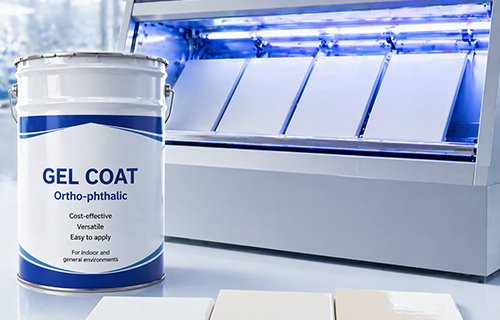
Your application method and your substrate decide how a colored gel coat performs in production. The same formulation can flow smoothly through one process and fight you in another. Check both before you commit to a product.
Spray, Brush, or Mold Application
Spray application suits large parts and long production runs. It lays down an even film and lets you control thickness across a broad surface. Brush application fits small batches, repair work, and complex shapes where a spray gun cannot reach. Mold application, where you apply the gel coat to the mold face first, sets the surface finish of the finished part. Each method demands a different viscosity and cure profile. A product built for spraying may sag when brushed. A brush grade may not atomize cleanly through a gun. Tell your supplier which method you use, and confirm the product suits it before you order. Ask for the recommended gun setup and flash-off time for your shop conditions.
Thickness is your practical checkpoint on the line. Aim for a wet film in a defined range, and verify it with a gauge before the coat cures.
A hydrolysis-resistant gelcoat (isophthalic-NPG or vinyl ester skin/barrier coat) with adequate gelcoat thickness — typically 0.4–0.6 mm — combined with full cure (verified by Barcol hardness) and minimal water-soluble content is the recommended defense against osmosis/blistering in FRP products.
A film below that range leaves the surface thin and vulnerable. A film above it can trap stress and waste material. Train your operators to check wet thickness on every batch, and log the readings.
Substrate and Coating Compatibility
The coating system works as a stack: base coat first, then color gel, then top coat. Each layer must bond to the one beneath it. Mixing brands across the stack invites adhesion failures and dull finishes.
For maximum longevity and performance, especially with gel, ensure that your base coat, color, and top coat are all chemically compatible, ideally from the same professional line.
A properly chosen base coat does real work. It improves adhesion to the substrate, strengthens the surface, helps colors stay true, and prevents base discoloration from showing through. Source the full stack from one manufacturer, and you remove the guesswork about compatibility. Substrate type matters too. A porous surface pulls resin away from the film. A sealed mold face releases the part cleanly. Match the base coat to the substrate, and the color layer sits on stable ground.
Custom colors come from mixing pigments into a base gel. Your supplier can match a RAL or Pantone target and deliver a batch that holds that color. Top coat choice follows the application and the customer requirement. An ultra-gloss top coat suits showroom finishes and marine surfaces. A matte or specialty finish fits other looks. Weigh the desired finish, the durability the part needs, and the drying speed your line allows. Keep a physical color chip on file for each product you run. Compare production parts against the chip under the same lighting. Run a sample panel through the full stack before full production.
Confirm Regulatory Compliance
Compliance checks protect your business from fines, shipment holds, and lost contracts. They also keep your products moving across borders. Two areas deserve your attention: emission limits and the paperwork trail.
VOC Limits and Safety Standards
Volatile organic compounds (VOCs) escape into the air as the gel coat cures. Many regions cap VOC content in coatings. The U.S. EPA sets national limits under its architectural and industrial maintenance coatings rules. Individual states, such as California, enforce stricter thresholds. The European Union regulates chemicals through REACH. Check the rules for every market where you sell, not just where you manufacture. A batch that passes at home may fail at the border.
Worker safety belongs in the same review. Gel coats contain styrene and other reactive chemicals. Confirm the supplier provides current safety data sheets (SDS) for each product. Verify that your spray booths, ventilation, and personal protective equipment meet local occupational safety rules. Train your operators on handling and storage. Keep eyewash stations and fire equipment close to the mixing area. Ask your supplier for guidance on local rules when you export to a new region.
Documentation and Recordkeeping
Paperwork proves your compliance during an audit or a customer review. Build a file for each gel coat product you use. Include the SDS, the technical data sheet, and any VOC or emissions declarations. Add certificates for ISO manufacturing where your customer requires them. Store these records where your team can find them quickly.
Traceability matters as much as the documents themselves. Record the batch number, the date of receipt, and the production run for every order. Link each finished part to its gel coat batch. This practice speeds up any recall or quality investigation. Digital systems make this easy. Scan each document at receipt and attach it to the batch record. Review your files on a schedule and replace outdated sheets. A clean, current record set turns a regulatory inspection into a routine event.
Evaluate Cost-Effectiveness
Initial Cost vs. Service Life
A low purchase price tells you little on its own. Multiply the price per unit by the number of parts you will coat, then compare that total against how long each part must last. A gel coat that costs more upfront can win the calculation when it protects a part for many years. A cheaper product that dulls or fades early forces you to replace or refinish the part, and that second cost often dwarfs the first.
Set your service life target before you compare quotes. A wind blade must hold its finish for decades. An indoor panel may need only a few years of good appearance. Ask each supplier for weathering data that covers your target. Then weigh the price against that evidence. The right choice balances the two, and it rarely lands on the lowest bid.
Rework, Waste, and Color-Match Costs
Rework drains profit faster than any line item on a quote. A gel coat that sags, cures unevenly, or drifts off the target color sends parts back through sanding and recoating. Each pass burns labor, material, and oven time. Track your rework rate by product and by batch. A product with a slightly higher price and a lower rework rate usually costs less per good part.
Waste and color matching add hidden costs. Film thickness drives material use, so hold your wet film to the recommended 0.4–0.6 mm range and stop over-spraying. Order color from a supplier who matches RAL or Pantone targets and holds that match batch to batch. Consistent color cuts the time your team spends sorting and touching up parts. Add these savings to the purchase price, and you see the true cost of each option.
Compare Colored Gel Coat Types
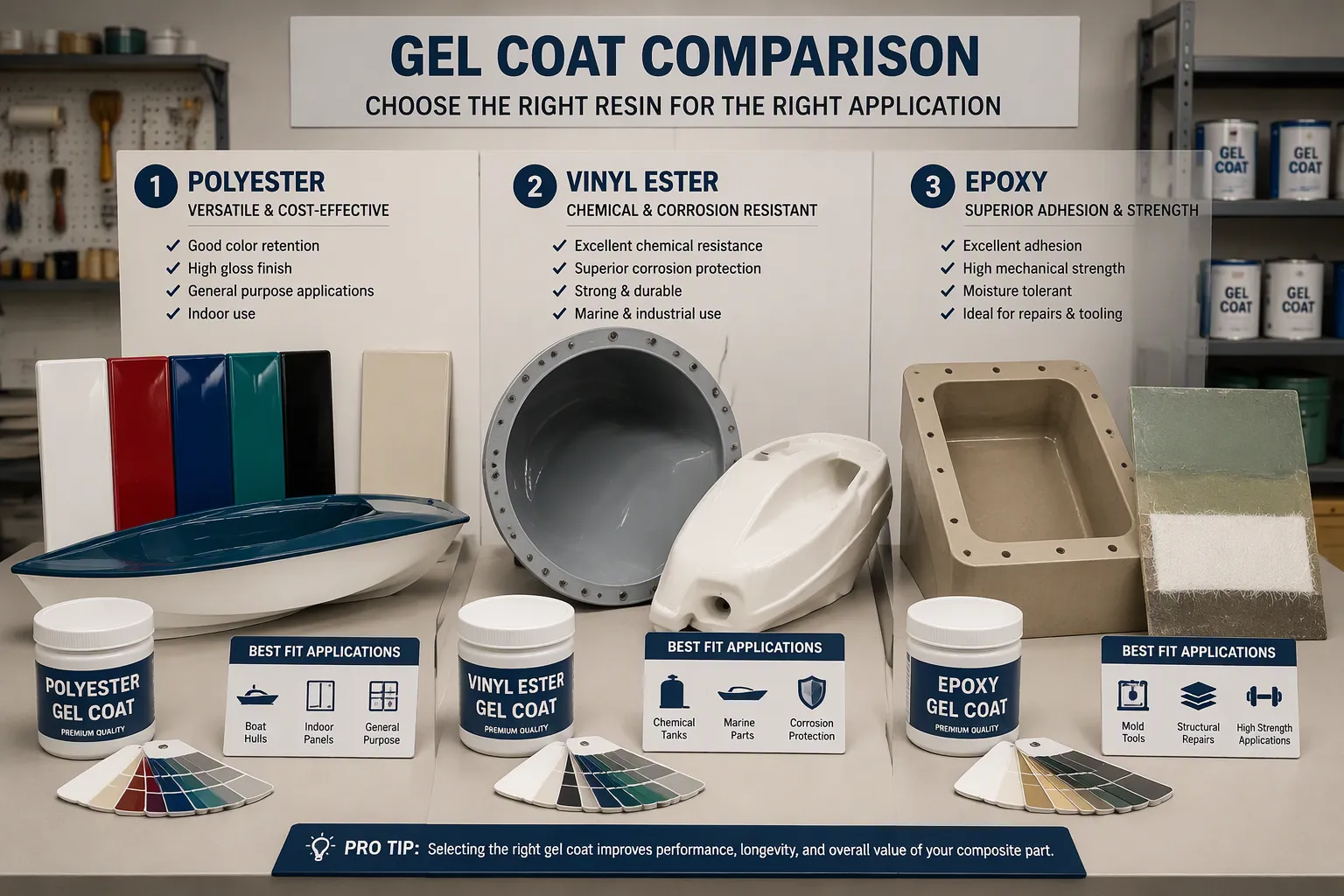
Polyester, Epoxy, and Vinyl Ester
Each resin family fits a different job. Polyester offers the most economical path. It suits indoor panels, general purpose parts, and high-volume runs where cost drives the decision. Ortho-phthalic polyester covers dry indoor use well. Isophthalic and NPG polyester grades add gloss retention and yellowing resistance, so they handle outdoor and marine surfaces. Vinyl ester sits above standard polyester in chemical and water resistance. It fits harsh marine environments, tank linings, and parts that meet solvents or constant moisture. Epoxy bonds strongly to many substrates and cures with low shrinkage. It fits tooling, structural repairs, and applications where adhesion matters most.
Resin type | Best fit | Watch for |
|---|---|---|
Polyester (ortho, iso/NPG) | Indoor panels, general purpose parts, marine surfaces with iso/NPG grades | Standard ortho grades fade outdoors |
Vinyl ester | Harsh marine, chemical contact, moisture-heavy service | Higher price than polyester |
Epoxy | Tooling, structural bonding, low-shrink needs | Different cure chemistry from polyester |
Matching Colored Gel Coat to Applications
Specialized formulations remove much of the guesswork. Rixin's MAXCOAT™ and ENCOAT™ line shows how far this tailoring goes. MAXCOAT™ Marine Gel Coat uses an iso/NPG base for gloss retention and yellowing resistance in harsh marine settings. MAXCOAT™ Wind Blade Gel Coat targets extreme weatherability and erosion resistance, protecting blades for over 20 years. The line also includes flat-panel gel coat for smooth, scratch-resistant FRP panels, halogen-free flame retardant gel coat for rail transit and building exteriors, and ENCOAT™ Sanitary gel coat for bathtubs and shower trays. General purpose brush and spray grades cover everyday work. Universal color paste delivers vibrant finishes, tooling gel coat extends mold life, sanding gel coat and primer support automotive topcoats, ortho-phthalic gel coat serves economical indoor use, and mechanically-made flat sheet gel coat fits logistics panels, RVs, tank containers, and high-end yachts.
Evaluate suppliers on the same checklist. Start with product scope: can one source cover your full stack, from base coat to top coat? Check customization options, including RAL and Pantone color matching and custom formulation. Confirm quality control through ISO manufacturing and joint lab testing. Ask for documentation, minimum order quantities, and sample availability. Finally, verify supply capability. Rixin brings over 28 years of composite expertise, five production sites, and 170,000+ tons of annual capacity, so batch-to-batch consistency holds across large orders. Request samples of each colored gel coat you plan to run, and test them on your own line before you commit.
Start with your performance requirements. Then confirm the process and substrate fit, check compliance, and weigh cost across the full service life. That order turns a crowded market into a clear decision.
Now move to action. Draft a requirements checklist for each part you coat. Request samples and color chips, and confirm base, color, and top coat compatibility with one supplier. Run a trial batch before full production. Test each colored gel coat on your own line, and record the results. A careful trial today protects your finish for years.
FAQ
How do I confirm a custom color will match my target?
Send your supplier a physical sample or a RAL or Pantone reference. Ask for a color chip made from the actual production formulation. Compare that chip to your target under the same lighting you use on the line. Keep the approved chip on file and check production parts against it.
What wet thickness should I target during application?
Aim for a wet film of 0.4–0.6 mm. Check the reading with a gauge before the coat cures. A thinner film leaves the surface vulnerable. A thicker film wastes material and can trap stress. Log the readings for each batch so you can trace any finish problem later.
Can one supplier cover my base coat, color gel, and top coat?
Yes, and one source is the safer choice. Layers from the same professional line bond more reliably and keep colors true. Ask whether the supplier offers the full stack, plus RAL or Pantone matching and custom formulation. Confirm ISO manufacturing and request documentation before you order.
How do I test a gel coat before full production?
Request samples and run a trial batch on your own line. Apply the full stack in the correct order, then check adhesion, color, and gloss. Record your settings and results. A careful trial protects your finish and catches problems while the fix is still cheap.
How do I judge a supplier's service-life claims?
Ask for weathering data that covers your target service life, not just delivery appearance. Compare that evidence across suppliers. Then check supply capability: production sites, annual capacity, and batch consistency. Rixin, for example, brings over 28 years of experience and 170,000+ tons of annual capacity.