



What is unsaturated polyester resin
 Oct 16, 2026|
 View:134
Unsaturated polyester resin is a thermosetting polymer that hardens permanently when cured. You will find it as the most widely used resin in the composites world, commonly called "fiberglass resin" or "laminating resin." This material shows up in your daily life more than you might expect. It forms boat hulls, car body panels, industrial pipes, and kitchen countertops. Manufacturers value it for its balance of strength, cost, and easy processing. You can shape it into complex parts with simple tools and room-temperature curing. That versatility explains its dominant position in modern composite manufacturing. Understanding this resin helps you make better decisions for your next project.
Key Takeaways
Unsaturated polyester resin is a versatile and affordable material used in many products, from boats to countertops.
You can easily shape and cure this resin at room temperature, making it perfect for DIY projects and industrial manufacturing.
This resin offers strong resistance to water, chemicals, and weather, ensuring long-lasting performance in tough environments.
Choose from different grades like orthophthalic, isophthalic, or vinyl ester to match your specific needs and budget.
While it has some limitations like styrene emissions, proper handling and recycling can minimize environmental impact.
Chemical Makeup of Unsaturated Polyester Resin
You can think of this resin as a carefully built molecular chain that stays liquid until you decide to harden it. Two main ingredients form that chain: polyols and unsaturated acids. Their reaction creates the backbone. A separate curing step then locks everything into a solid network.
Polyols and Unsaturated Acids
Manufacturers produce unsaturated polyester resin through a controlled polycondensation reaction. This esterification process combines an unsaturated acid or anhydride with a diol or glycol.
Industrial UPR is produced by a controlled polycondensation (esterification) of an unsaturated acid or anhydride (e.g., maleic anhydride or fumaric acid) with a diol/glycol (e.g., ethylene glycol, propylene glycol).
The reaction takes place at elevated temperatures. Glycols and dibasic acids react together. Ester linkages form as the reaction proceeds. Water leaves as a by-product. The molecular weight of the resin gradually increases.
Component Category | Typical Examples |
|---|---|
Polyols (Glycols) | Ethylene Glycol (EG), Propylene Glycol (PG), Diethylene Glycol (DEG), Neopentyl Glycol (NPG) |
Unsaturated Dibasic Acids | Maleic Anhydride, Fumaric Acid |
Saturated Dibasic Acids (co-monomers) | Phthalic Anhydride, Isophthalic Acid, Adipic Acid, Terephthalic Acid |
The unsaturated acids give the resin its reactive carbon-carbon double bonds. These double bonds enable crosslinking later. Saturated acids act as co-monomers. They adjust the spacing between double bonds and control the final crosslink density. A higher unsaturation level leads to faster curing and greater hardness. A higher polyol functionality creates a more rigid network with greater hardness and abrasion resistance.
Styrene serves as the common reactive diluent. It keeps the resin liquid and participates in the curing reaction. Specialty formulations exist for specific performance needs.
Curing Process
The resin stays liquid because inhibitors prevent premature polymerization. You trigger the cure by adding an initiator. MEKP (Methyl Ethyl Ketone Peroxide) is the primary peroxide initiator for room-temperature cure. A cobalt accelerator, such as cobalt octoate or cobalt naphthenate, promotes the reaction at ambient temperatures. This pairing of MEKP with cobalt is standard for UPR curing.
The curing sequence follows these steps:
MEKP decomposes to generate free radicals.
Cobalt salts catalyze the redox decomposition of MEKP at ambient temperatures.
The reaction releases heat internally, sustaining cross-linking throughout the laminate thickness.
Styrene bridges polymer chains, converting the liquid resin into a rigid, cross-linked thermoset matrix.
This exothermic polymerization converts the liquid into a solid thermoset. The final properties depend on crosslink density. High crosslink density gives greater hardness, improved heat resistance, and better solvent durability, but reduced flexibility. Moderate crosslink density produces flexible and tough films. You can tune the formulation to achieve the balance your application needs.
Key Properties
Strength and Durability
You get solid mechanical performance from cured unsaturated polyester resin. The material offers good tensile strength, stiffness, and dimensional stability. Glass-reinforced versions perform even better. A glass-polyester composite achieved a dry tensile strength of 92.28 ± 2.32 MPa. Natural fiber options provide lower but still useful values.
Composite Type | Tensile Strength (MPa) |
|---|---|
Bio-based UPR + bamboo mat (30 wt.%) | 13.6 ± 0.8 |
Bio-based UPR + flax mat (30 wt.%) | 39.8 ± 3.0 |
Bio-based UPR + flax mat (30 wt.%, variant) | 42.7 ± 2.9 |
Typical bamboo-based UPR composites | 15–25 |
Typical non-woven flax mat UPR composites | 30–40 |
You can tune flexibility, heat resistance, and elongation through formulation changes.
Chemical and Weather Resistance
Cured UPR handles harsh environments well. The material resists water, salt, acids, and alkalis. It also provides good hydrolysis resistance. These traits support its use in boat hulls, automotive panels, electrical enclosures, and industrial tanks.
Marine-grade resins deliver especially strong performance against seawater and salt. You can select grades for specific chemical exposure. This tunability lets you match the resin to your application. Proper formulation gives you the durability your project demands.
Types and Forms
Ortho, Iso, and Specialty Grades
You will find several grades of unsaturated polyester resin on the market. Each grade targets a different balance of cost and performance. Orthophthalic resin uses phthalic anhydride as its base. It costs less and works well for general-purpose applications. You can use it for non-critical structural components, GRP sheets, and indoor products. It offers a good price-performance balance when chemical exposure is not a concern.
Isophthalic resin uses isophthalic acid instead. It delivers better water resistance, higher chemical resistance, and improved mechanical properties. You can use it for potable water tanks, diesel tanks, and outdoor FRP products. Food-grade versions may meet FDA compliance. This grade costs more upfront, but it lowers the risk of premature failure. Vinyl ester resin sits at the high-performance end with superior chemical resistance. Other specialty grades include DCPD for structural parts, brominated for flame retardancy, and custom formulations for marine, automotive, and industrial needs.
Type | Raw Material | Key Properties | Typical Applications |
|---|---|---|---|
Orthophthalic | Phthalic anhydride | Most economical; lower water resistance | General-purpose parts, GRP sheets, indoor products |
Isophthalic | Isophthalic acid | Better water and chemical resistance | Potable water tanks, diesel tanks, outdoor FRP |
Vinyl ester | Epoxy-based | Superior chemical resistance | Chemical equipment, marine engineering |
Liquid and SMC Forms
Suppliers deliver this resin in several physical forms. Liquid laminating resin remains the most common. You use it for hand layup, spray-up, and filament winding. Casting resin flows into molds for electrical components and decorative parts. Pultrusion resin suits continuous profiles like rods and tubes. These liquid forms give you flexibility for open-mold and closed-mold processes.
Sheet molding compound (SMC) and bulk molding compound (BMC) represent paste and sheet forms. SMC uses chopped glass fibers around 1 inch long. It provides higher mechanical strength, superior surface finish, and excellent dimensional stability. You will see SMC in automotive body panels, EV battery covers, and electrical enclosures. BMC uses shorter fibers under 0.25 inches. It offers excellent electrical insulation and works well for small, intricate parts like circuit breaker housings and motor end caps. Both forms cure permanently and cannot be remelted. The nicknames "fiberglass resin" and "laminating resin" refer to these liquid forms in everyday use.
Applications of Unsaturated Polyester Resin
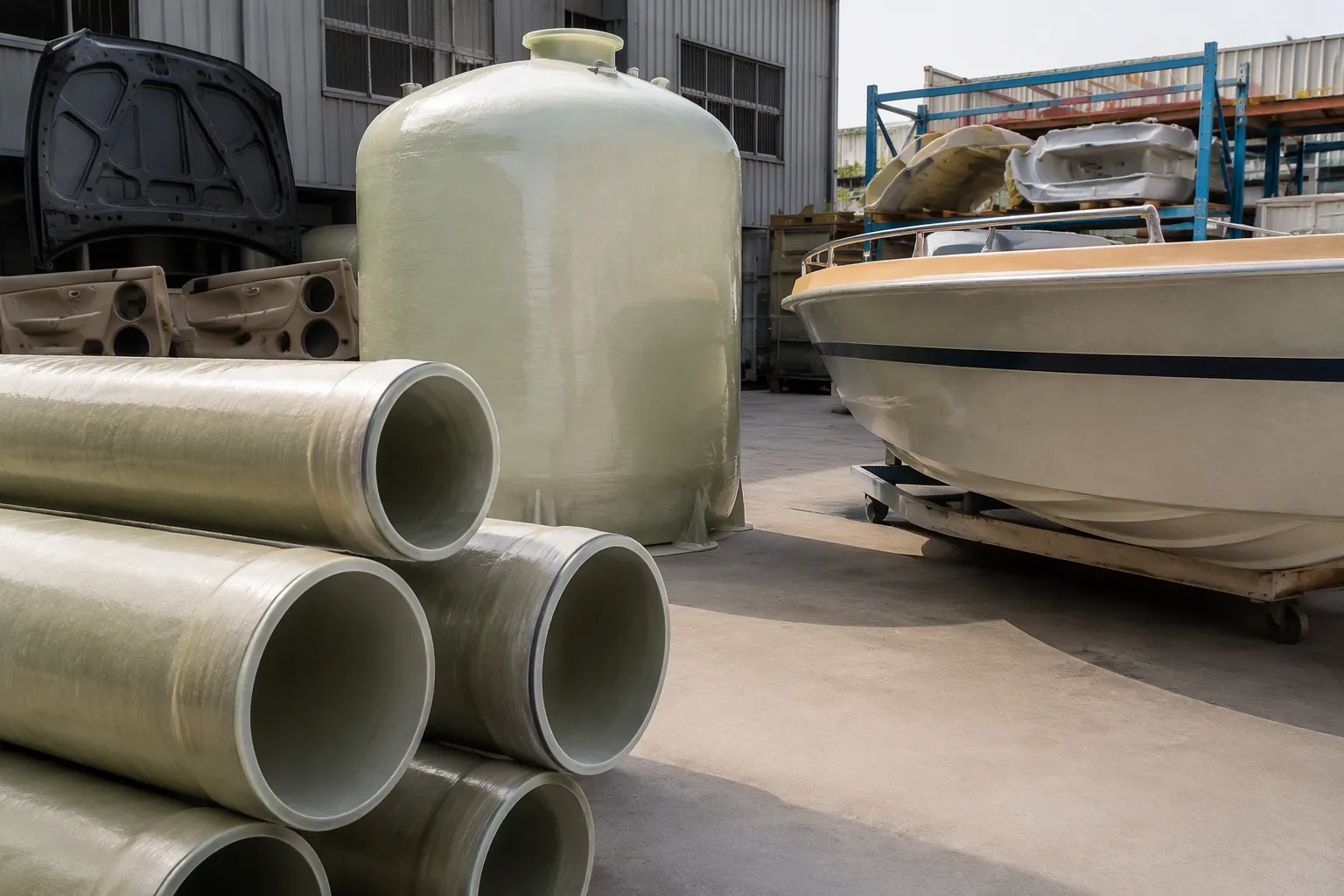
You will find this resin in more industries than almost any other composite material. Its low cost, easy processing, and strong performance make it a practical choice for large-scale production. From underground pipes to wind turbine blades, it handles demanding conditions across many sectors.
Construction and Infrastructure
Builders rely on this resin for durable, corrosion-resistant structures. You can see it in roofing panels, pipes, and tanks that resist water and chemicals. Reinforced building materials use it to add strength without adding much weight. Infrastructure composites benefit from its long service life and low maintenance needs.
Common construction applications include:
FRP pipes for water and chemical transport
Storage tanks and pressure vessels
Septic tanks for wastewater treatment
Gratings and guardrails for industrial facilities
Door and window profiles
Photovoltaic brackets for solar installations
These products resist rust, rot, and chemical attack. They last for decades in harsh outdoor environments. That durability lowers replacement costs over time.
Automotive and Marine
Automakers and boat builders use this resin for parts that need strength and light weight. Engine hood covers, interior panels, and structural components all benefit from its properties. Sheet molding compound (SMC) and bulk molding compound (BMC) forms work well for automotive parts.
Marine-grade formulations use isophthalic acid instead of phthalic anhydride. This change delivers superior hydrolytic stability and corrosion resistance.
Wind energy represents another major application. Manufacturers use vacuum infusion to build turbine blades and nacelle covers. These parts need lightweight durability for long-term performance and efficiency. Research under the Interreg Aurora-funded SUSBICO project is developing biobased versions from furfural-derived monomers for wind turbine use.
Electronics and electrical engineering also depend on casting resin. You will find it in insulation parts, circuit components, and decorative industrial pieces. The resin protects sensitive components from moisture and electrical interference.
Changzhou Rixin Resin Co., Ltd. stands as a leading manufacturer in this space. Rixin supplies over 170,000 tons annually. The company uses full-process DCS intelligent control and an ISO manufacturing system. Their marine resin holds CCS approval for ship and yacht construction. Rixin offers custom formulation services, free 1–5kg samples, and factory-direct pricing for global buyers.
Advantages and Limitations
Key Advantages
You get strong value from this resin because it balances performance and cost better than most alternatives. Material costs stay low, so you can produce large parts without a large budget. Epoxy resin costs more because it targets advanced performance. For many industrial FRP applications, that extra cost buys more than you need.
Processing speed also works in your favor. The resin cures quickly at room temperature, which shortens cycle times and boosts output. Epoxy usually demands tighter control over mixing ratios, curing conditions, and temperature management. You avoid much of that complexity here.
Advantage | UPR Characteristics | Comparison with Epoxy |
|---|---|---|
Cost efficiency | Lower material cost | Epoxy costs more |
Fast processing | Fast cure, efficient output | Epoxy needs precise control |
Manufacturing flexibility | Hand layup, filament winding, pultrusion, RTM, compression molding | Epoxy suits high-performance uses |
Large-scale manufacturing | Suits large FRP components | Epoxy costs and processing run higher |
You can also choose from many molding methods. Hand layup, spray-up, resin transfer molding, pultrusion, and filament winding all work well. This flexibility lets you match the process to your part shape and production volume. Large FRP components become practical, and the strength-to-weight ratio stays favorable. A wide formulation range means you can tune the resin for corrosion resistance, flexibility, or heat performance.
Limitations
You should plan for styrene emissions during open-mold processing. Styrene is a volatile organic compound, and conventional thermoset fabrication releases it. You can reduce exposure with the right process controls.
Shrinkage during cure can affect dimensional accuracy, especially in large parts. The resin also offers lower heat resistance than epoxy and limited fatigue performance under repeated loading. Without a gelcoat, ultraviolet exposure degrades the surface over time.
Recycling remains difficult. Thermosets are not typically recyclable, though chemical recycling can convert them back into raw materials or monomers. FRP products can exceed 20-year service lifetimes, and end-of-life material can be crushed for filler in building materials.
Unsaturated polyester resin is a thermosetting polymer built from unsaturated acids and diols. Styrene crosslinks it into a permanent solid. You get strength, corrosion resistance, and remarkable versatility from one affordable material. That combination keeps it the dominant resin in composites worldwide. Construction, marine, automotive, and wind energy all depend on it for pipes, hulls, panels, and turbine blades. The market reflects this demand. Manufacturers like Rixin keep expanding what this resin can do through specialized grades and custom formulations.
FAQ
How long does unsaturated polyester resin last?
You can expect FRP products to exceed 20-year service lifetimes. Marine-grade versions resist seawater, salt, and hydrolysis for decades. Proper gelcoat protection extends surface durability against UV degradation. Storage life for liquid resin depends on inhibitor levels and temperature control.
Can you repair cured polyester resin?
Yes. You can sand the damaged area and apply fresh laminating resin. The styrene in new resin softens the old surface slightly. This creates a chemical bond between layers. Marine and automotive repair kits rely on this compatibility for hull and panel fixes.
Is polyester resin the same as fiberglass resin?
The nickname "fiberglass resin" refers to unsaturated polyester resin in liquid form. You use it to wet out glass fibers during layup. The resin itself contains no glass. The composite gets its strength from the fiber reinforcement.
What triggers the curing reaction?
You add MEKP initiator and cobalt accelerator to start curing at room temperature. The reaction generates its own heat and sustains crosslinking. Higher initiator levels speed the cure but risk cracking from excess exotherm. Always follow the supplier's ratio recommendations.
Which resin grade suits marine use?
Isophthalic and vinyl ester grades deliver the best seawater resistance. They resist hydrolysis and salt attack better than orthophthalic types. Rixin's marine resin holds CCS approval for ship and yacht construction. Choose based on your exposure conditions and budget.